
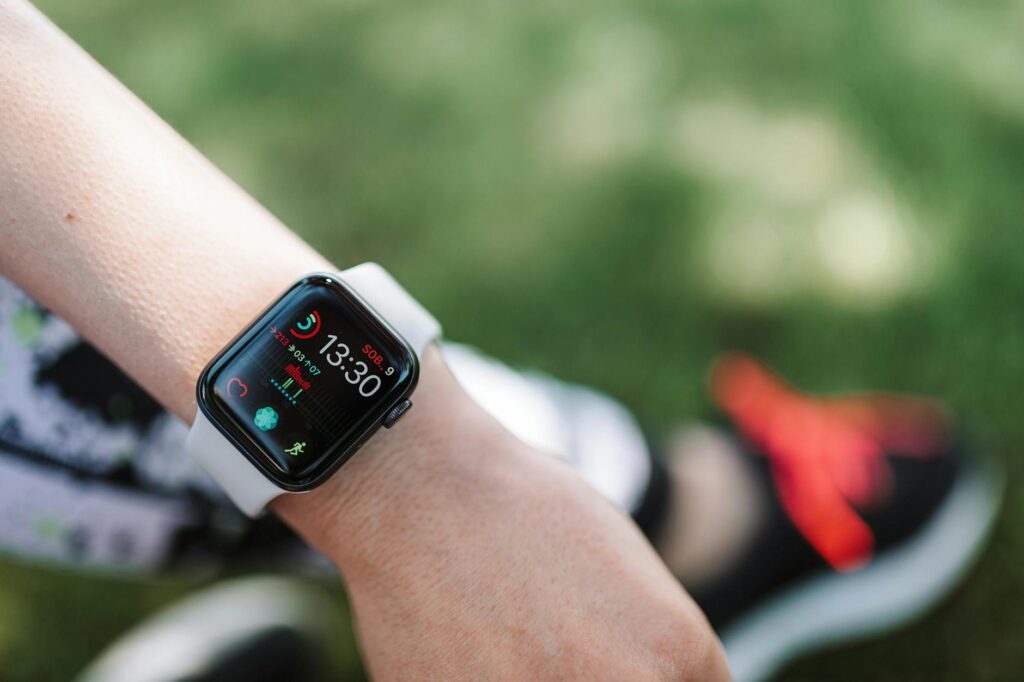
Bottom line: This review covers the Series 10, which is no longer the watch to buy. New stock has effectively gone and renewed units sit near $279, while a brand new Apple Watch Series 11 is $299 with a warranty and newer health features. If you want those features cheaply, the Apple Watch SE 3 is $219 and carries the same sleep score, sleep apnea notifications and Vitals tracking. Prices checked July 2026. The full Series 10 assessment below still stands on its own terms, and the buying advice has moved on.
Check Series 11 Price → Check SE 3 Price →
Apple Watch Series 10 Review: Is the Thinner Design Worth It?
Apple Watch Series 10 is meaningfully thinner, slightly lighter, and faster to charge than Series 9. Here is the complete athlete-focused review after extended daily use.
Apple Watch Series 10 is the best Apple Watch ever made: thinner and lighter than any predecessor, with a wider display crammed into the same footprint, faster 80-minute charging, and sleep apnea detection as a new health feature. For athletes on Series 7 or older, it is a clear upgrade. For Series 9 owners, the differences are real but not urgent. The battery remains the one limitation for sleep-tracking athletes, still requires daily charging.
What Changed From Series 9

The Thinner Case
Series 10’s case is 9.7mm thick, down from Series 9’s 10.7mm. That 1mm difference sounds minimal but produces a watch that sits noticeably flatter on the wrist, feels less obtrusive under a shirt cuff, and reduces the “sporty computer” look that makes some Series 9 owners self-conscious in non-athletic settings. Combined with an aluminum case that comes in three new polished finishes (jet black, rose gold, silver), the Series 10 is the most versatile Apple Watch yet for dual athletic/professional wear.
Wider Display in Same Footprint
The display is 10% larger than Series 9 despite the same external case dimensions, achieved through thinner bezels and a wider aspect ratio. Text, metrics, and watch faces are noticeably easier to read at a glance. For athletes checking heart rate zones mid-effort, the larger numbers make a genuine usability difference compared to previous generations.
Faster Charging
Series 10 charges to 80% in 30 minutes, up from 45 minutes on Series 9. Full charge in approximately 75–80 minutes. For athletes who charge during morning routines, this matters: 30 minutes on the charger while showering and getting ready provides enough battery for a full training day plus overnight sleep tracking (if remaining battery is managed). This is the feature that most changes the sleep-tracking feasibility on Apple Watch.
Sleep Apnea Detection
Series 10 introduces FDA-cleared sleep apnea detection, a new capability that uses the accelerometer to detect breathing irregularities during sleep and alerts users who may have undiagnosed sleep apnea. For athletes who have noticed poor sleep quality, high resting heart rate, or persistent fatigue without clear cause, this feature has genuine health screening value. It does not replace a sleep study but can identify whether further evaluation is warranted.
What Stayed the Same
The health and fitness tracking sensor suite is largely carried over from Series 9: the same heart rate sensor, same optical blood oxygen monitor, same ECG capability, same temperature sensor, same crash and fall detection. The workout tracking algorithms and GPS accuracy are equivalent. Battery life is 18 hours: unchanged from Series 9, still the primary limitation for serious sleep-tracking athletes.
Fitness Tracking Assessment
Apple Watch Series 10’s workout tracking is excellent for the use cases it is designed for: calorie tracking, heart rate zone monitoring, GPS route recording, and Activity ring motivation. The heart rate accuracy during steady-state aerobic exercise (running, cycling) is among the best in consumer wrist devices. GPS accuracy in open environments is very good; it degrades more than Garmin in dense urban environments and tree cover.
The training analytics remain shallow compared to Garmin. There is no equivalent to Garmin’s Training Readiness, Training Load, or Body Battery concepts. Apple Watch tells you what you did; Garmin tells you how that affects your capacity to train tomorrow. For general fitness users and lifestyle athletes, Apple’s approach is sufficient. For athletes following periodized training programs, Garmin or WHOOP provides more actionable guidance.
Series 10 vs Series 9: Should You Upgrade?
| Feature | Series 10 | Series 9 |
|---|---|---|
| Price | $399 (aluminum) | $299 (now discounted) |
| Thickness | 9.7mm | 10.7mm |
| Display | Larger (same footprint) | Slightly smaller |
| Charging | 80% in 30 min | 80% in 45 min |
| Sleep Apnea Detection | ✅ Yes | ❌ No |
| Battery | 18 hours | 18 hours |
| Processor | S10 | S9 (same performance) |
| GPS | ✅ Equivalent accuracy | ✅ Equivalent accuracy |
| Best for | New buyers, Series 7 and older owners | Still excellent, buy discounted |
Who Should Buy Series 10 (Original 2024 Verdict)
Written when the Series 10 was current at $399. That price and that advice no longer hold, and the updated recommendation is in the 2026 section above. At the time: for new Apple Watch buyers starting fresh, the Series 10 at $399 was the correct purchase, with the design, charging speed and sleep apnea detection justifying it. Today a new Series 11 costs $299 and a new SE 3 costs $219, so neither the price nor the conclusion survives. Athletes on Series 8 or 9. The upgrade is not urgent. The core health and fitness capabilities are equivalent. Buy Series 10 when your current watch needs replacement or when sleep apnea detection is a specific health priority. Athletes on Series 6 or older, upgrade is worth it. The sensors, processing speed, and charging improvements are meaningful versus older hardware. Athletes who primarily want recovery tracking data, consider adding Oura Ring Gen 4 instead. It provides better sleep and HRV data than any Apple Watch generation at better battery life.
Should You Still Buy a Series 10 in 2026?
This review was written when the Series 10 was current. It is not any more, and the buying maths has changed enough that the honest answer is usually no.
New Series 10 stock has largely gone. What remains on Amazon is renewed units at around $279. A brand new Apple Watch Series 11 is $299. Paying $279 for a refurbished two-generation-old watch to save $20 against a new current one with a fresh warranty is not a trade worth making, and we would rather say so plainly than keep sending readers at the older model.
The Series 11 adds things the Series 10 does not have: a daily sleep score, hypertension notifications, and the Vitals overnight tracking view. Whether those change your life is a separate question, but they are real additions rather than a spec bump.
Check Apple Watch Series 11 Price →
The more interesting option is the one Apple markets least. The Apple Watch SE 3 is $219 and carries the same headline health features: sleep score, sleep apnea notifications, the Vitals app, irregular rhythm alerts and high and low heart rate alerts. The $80 gap to the Series 11 buys the always-on display, the larger and brighter screen, ECG, and the faster chip. It does not buy the health tracking, which is what most people think they are paying for.
Check Apple Watch SE 3 Price →
So the shortlist for an Apple user in 2026 is the SE 3 at $219 if you want the health features cheaply, or the Series 11 at $299 if the always-on display and ECG matter to you. The Series 10 is no longer on that list. If you are open to leaving the Apple ecosystem entirely, our running watch roundup covers watches with far better battery life, and our guide to the validation research explains what any of these wrist sensors can and cannot actually measure.
Specs and Compatibility Questions
Is Apple Watch Series 10 waterproof?
Series 10 introduces WR100 water resistance (100 meters), a significant upgrade from Series 9’s WR50 rating. This makes it suitable for recreational scuba diving, open water swimming, and water sports that involve high-velocity water entry. Previous Apple Watch models were rated for swimming and showering but not for depths beyond 50 meters.
Does Apple Watch Series 10 work with Android?
No, Apple Watch requires an iPhone running iOS 17 or later. It does not pair with Android phones. For Android users, Garmin, Samsung Galaxy Watch, or Fitbit are the appropriate alternatives.
Is the Apple Watch Series 10 titanium worth it?
The titanium Series 10 ($699) adds a lighter, more scratch-resistant case versus the aluminum at $399. For athletes who are rough on wearables or who want reduced weight for extended activities, the titanium upgrade is justifiable. For most users, the aluminum case in polished finish provides the same aesthetics at $300 less.
How does Series 10 sleep tracking compare to Oura Ring?
Apple Watch Series 10 sleep staging is good for a wrist device, significantly better than it was 3 generations ago. Oura Ring Gen 4’s finger-based measurement is more accurate for HRV and produces more clinically reliable sleep staging data. The practical difference: Oura’s Readiness Score is more actionable for training decisions than anything Apple Watch provides. For sleep tracking alone, Oura remains the better device; Apple Watch’s advantage is that it does everything else too.
Related: Apple Watch Series 9 Review · Apple Watch vs Garmin for Running · Best All-in-One Fitness Watch · Best Smartwatch for Women
Sport-by-Sport Workout Accuracy
Apple Watch Series 10 performs differently across training disciplines. Here is an honest breakdown based on extended use:
Running
Heart rate accuracy during running is consistently strong, within 2–3 bpm of a chest strap during steady-state efforts. Pace and distance via GPS are accurate in open environments, typically within 1–2% of measured courses. In dense urban corridors with tall buildings, GPS drift is noticeable but not severe. Cadence, stride metrics, and vertical oscillation are not available natively, runners who want those metrics need a Garmin or dedicated running watch.
Cycling
For casual and fitness cyclists, Series 10 tracks speed, distance, heart rate, and calories well. It does not connect to power meters, which eliminates it for serious cyclists training with power. The wrist-based heart rate is less accurate during high-intensity intervals on the bike due to wrist movement, a Bluetooth chest strap paired to the watch significantly improves data quality. The Cycling workout mode integrates with Apple Maps for turn-by-turn navigation, which is genuinely useful.
Strength Training
Series 10 auto-detects sets and reps during strength training more reliably than most smartwatches. This is one area where Apple’s motion algorithms genuinely stand out. It identifies exercises, counts reps, and tracks rest periods automatically. The limitation is that it does not log actual weight lifted, so progressive overload tracking still requires a separate app like Hevy or Strong.
Swimming
Water resistance to 50 meters. Pool swim mode tracks laps, stroke type, SWOLF score, and active calories. Open water swim mode records GPS route and distance. Heart rate is not measured during swimming, optical sensors do not work reliably through water. Post-swim heart rate is captured. For competitive swimmers this is a limitation; for fitness swimmers tracking distance and effort it is adequate.
HIIT and Group Fitness
The heart rate sensor struggles during intense wrist-movement exercises: burpees, box jumps, kettlebell swings. Readings can lag 10–15 seconds during rapid intensity shifts. For HIIT athletes who rely on real-time heart rate zones, a chest strap or Polar H10 paired via Bluetooth is a meaningful upgrade in data accuracy.
Apple Watch Series 10 vs Series 9 vs Ultra 2
Here is how the current Apple Watch lineup stacks up for athletes:
| Feature | Series 10 | Series 9 | Ultra 2 |
|---|---|---|---|
| Case thickness | 9.7mm | 10.7mm | 14.4mm |
| Display size | 46mm: 2,000 nits | 45mm: 2,000 nits | 49mm: 3,000 nits |
| Battery life | 18 hours | 18 hours | 60 hours |
| GPS | L1 GPS | L1 GPS | L1 + L5 precision GPS |
| Charging speed | 80% in 30 min | 80% in 45 min | 80% in 45 min |
| Water resistance | 50m | 50m | 100m |
| Sleep apnea detection | Yes | No | No |
| Depth gauge | No | No | Yes |
| Siren | No | No | Yes |
| Starting price | $399 | $329 (refurb) | $799 |
The Ultra 2 is the right choice for endurance athletes who need multi-day battery life, trail runners who benefit from precision GPS in remote environments, or divers who need the depth gauge and siren. For everyone else, Series 10 offers a better daily experience than Series 9 at a reasonable step up in price.
The watchOS Health Ecosystem
One underrated advantage of Apple Watch is the depth of watchOS and its third-party app ecosystem. Features that matter for athletes specifically:
Health app integration: Every metric Apple Watch collects feeds into the iPhone Health app automatically: resting heart rate trends, sleep stages, VO2 max estimates, cardio fitness history, menstrual cycle tracking, and now sleep apnea detection. The longitudinal health picture builds over months and years in a way that few other platforms match.
Strava, Nike Run Club, MyFitnessPal: All integrate natively. Workouts recorded on Apple Watch sync automatically to Strava with route, heart rate, and pace data. MyFitnessPal reads activity calories directly from the Health app for net calorie calculations.
Athlytic and Training Today: Third-party recovery and readiness apps built specifically for Apple Watch give HRV-based recovery scores comparable to WHOOP, using data the watch already collects. Athlytic in particular is a strong free alternative for athletes who want recovery guidance without a WHOOP subscription.
Limitations: Garmin Connect, Garmin Training Peaks integration, and Garmin’s proprietary training load and body battery metrics are not available on Apple Watch. Athletes deep in the Garmin ecosystem will not find equivalent tools on watchOS.
Who Should Buy the Apple Watch Series 10
Series 10 is the right watch if:
- You are on Series 7 or older and want a meaningful hardware upgrade: the thinner case, faster charging, and larger display are all noticeable
- You train across multiple disciplines (running, lifting, swimming, cycling) and want one watch that covers all of them adequately
- You want the best daily smartwatch experience (notifications, payments, Siri, and app ecosystem) alongside fitness tracking
- You already use iPhone and the Apple health ecosystem and want seamless integration
- Sleep apnea detection is personally relevant to you
Series 10 is not the right watch if:
- You train seriously with power meters, need advanced running dynamics, or follow structured training plans, a Garmin Forerunner is the better fit
- You need multi-day battery life for ultramarathons, expeditions, or simply dislike daily charging
- You are already on Series 9 and satisfied. The upgrade is real but not urgent enough to justify the cost
- Budget is the primary concern, a refurbished Series 9 at $329 delivers 90% of the experience for less
Frequently Asked Questions
Is Apple Watch Series 10 worth upgrading from Series 9?
If you primarily care about fitness tracking, no, the sensor suite is largely the same. If the thinner design, faster charging, or sleep apnea detection matters to you personally, the upgrade is worthwhile. Series 9 owners who are satisfied should stay put for another cycle.
How accurate is the heart rate monitor on Apple Watch Series 10?
Very accurate during steady-state cardio: running, cycling, and rowing at consistent intensities. Less accurate during high-intensity interval work or exercises with significant wrist movement. For precision heart rate training, pair it with a Bluetooth chest strap like the Polar H10.
Can Apple Watch Series 10 replace a Garmin for runners?
For recreational and fitness runners tracking pace, distance, and heart rate, yes. For competitive runners who need cadence, ground contact time, vertical oscillation, structured interval workouts, or race pace prediction, no. Garmin’s running-specific analytics are significantly deeper.
Does Apple Watch Series 10 track sleep?
Yes: sleep stages (REM, core, deep), sleep duration, and now sleep apnea detection (which requires 30 nights of data collection before it can flag potential issues). The daily charging requirement means you need to charge during a window in your day rather than overnight, which takes adjustment.
What is the best Apple Watch for athletes in 2026?
For most athletes, Series 10 is the best balance of performance, design, and price. Endurance athletes who need multi-day battery and precision GPS should consider the Apple Watch Ultra 2 despite the $799 price. Athletes who prioritize structured training analytics over the Apple ecosystem should look at the Garmin Forerunner 265 or 965 instead.