
Bottom Line Up Front
Best overall: Banded Loop Resistance Bands by Fit Simplify ($14): five resistance levels, durable fabric-wrapped latex, handles daily use without rolling or snapping. Best heavy-duty: Rogue Monster Bands ($28–$42), thick rubber bands for serious hip thrusts and barbell-assisted movements. Best fabric: Peach Bands ($22): stay in place during lateral work, comfortable on skin, no rolling. Best for travel: Theraband CLX ($18): versatile looped design works for upper and lower body, packs flat.
The best-value loop band set for glute work u2014 five resistance levels that cover every activation and burnout move.
Why Resistance Bands Are the Best Glute Tool You’re Not Using
Barbells and dumbbells load the glutes through a limited range of motion. The tension is highest at the bottom of a squat or hip thrust and drops significantly at the top, where glute activation actually peaks. Resistance bands do the opposite: tension increases through the range of motion, loading the glutes hardest at full hip extension, exactly where you need it most for glute development.
Combining band resistance with free weights does appear to raise glute activation, though the evidence is thinner than it is usually made to sound. A study in the International Journal of Strength and Conditioning measured surface EMG in ten men performing barbell hip thrusts and glute bridges with and without band-resisted abduction, and found the banded versions produced significantly greater activity in the upper gluteus maximus. That is a real finding from a small sample, and it is narrower than the claim we previously published here. An earlier version of this article cited a specific 21 percent activation increase attributed to a 2019 paper in the Journal of Human Kinetics. We could not verify that study or that figure on re-checking, so we have removed it rather than leave an unverifiable number in place. The abductors and hip external rotators (often undertrained) receive direct stimulus from lateral band work that barbell training does not address.
For home training athletes, bands are the highest-value glute training tool available: they pack flat, cost $15–40, and cover activation work, strength training, and accessory movements in one piece of equipment.
The Two Band Types and When to Use Each
Loop Bands (Mini Bands)
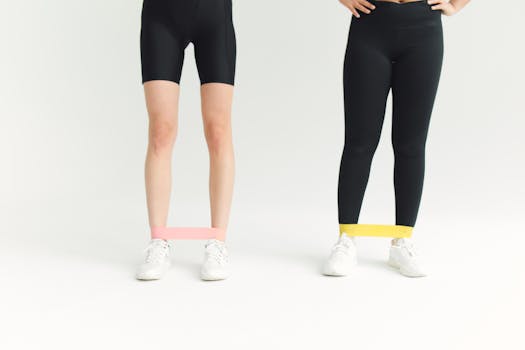
Short, closed loops, typically 9–12 inches long and 2–4 inches wide. These are the standard tool for glute activation and lateral work. Place above the knees for squats, clamshells, lateral walks, and kickbacks. Place around the ankles for hip abduction variations. The short length keeps constant tension through all positions. Best choice for glute-focused training.
Long Loop Bands (Monster Bands)
Longer, thicker rubber bands, typically 40–45 inches and available in heavy resistances up to 200+ lbs of tension. Used for banded barbell movements (hip thrusts, squats, deadlifts), assisted pull-ups, and full-body stretching. For glute training specifically, these are used to add accommodating resistance to barbell hip thrusts: anchored under the barbell and over the hips, they load the lockout position where glute activation is highest.
The Five Best Resistance Bands for Glutes
#1 Best Overall: Fit Simplify Resistance Loop Bands
The Fit Simplify set covers the full resistance range most athletes need: extra light through extra heavy in five bands. The natural latex construction is durable enough for daily use. These do not snap or lose elasticity within a few months like cheap alternatives. The fabric-wrapped texture prevents rolling during lateral movements, which is the most common complaint with smooth latex mini bands. At $14 for five bands, the price-per-session cost is effectively zero. For most athletes looking for a single resistance band purchase, this is the correct choice.
Natural latex · 5 resistance levels · Fabric-wrapped · Includes carry bag
#2 Best Heavy-Duty: Rogue Monster Bands
Rogue’s Monster Bands are the standard for athletes adding resistance to barbell movements. The heavy-gauge rubber construction handles repeated loading from 50–200+ lbs without degrading. For banded hip thrusts (the highest ROI barbell-plus-band exercise for glute development) the X1 (35 lbs) and X2 (60 lbs) sizes are the most commonly used. The flat rubber construction is not comfortable for direct skin contact during lateral walks, so these are primarily tool for barbell work rather than bodyweight activation.
Heavy-gauge rubber · Multiple resistance levels · For barbell work and assisted movements
#3 Best Fabric Band: Peach Bands
Fabric bands eliminate the two main complaints with latex mini bands: rolling and skin pinching. The woven fabric construction stays in place during lateral shuffles and squats, and feels comfortable on bare skin during summer training. Peach Bands are specifically designed for glute and hip work, the resistance levels are calibrated for the strength demands of glute exercises rather than general fitness. The medium and heavy bands cover most athletes’ needs for lateral walks, clamshells, and bodyweight squats. Not suitable for banded barbell work, use Rogue Monster Bands for that.
#4 Best for Travel: Theraband CLX
The CLX is a looped therapy band with finger loops, a design that makes it versatile for upper and lower body work without anchors. For glute training on the road, it handles clamshells, kickbacks, standing abduction, and banded squats from a single band. Packs completely flat. The therapy-grade latex construction is high quality. The resistance levels top out lower than athletic bands, making it best for activation work and travel training rather than strength-focused sessions.
The Five Best Glute Exercises with Resistance Bands
1. Banded Hip Thrust
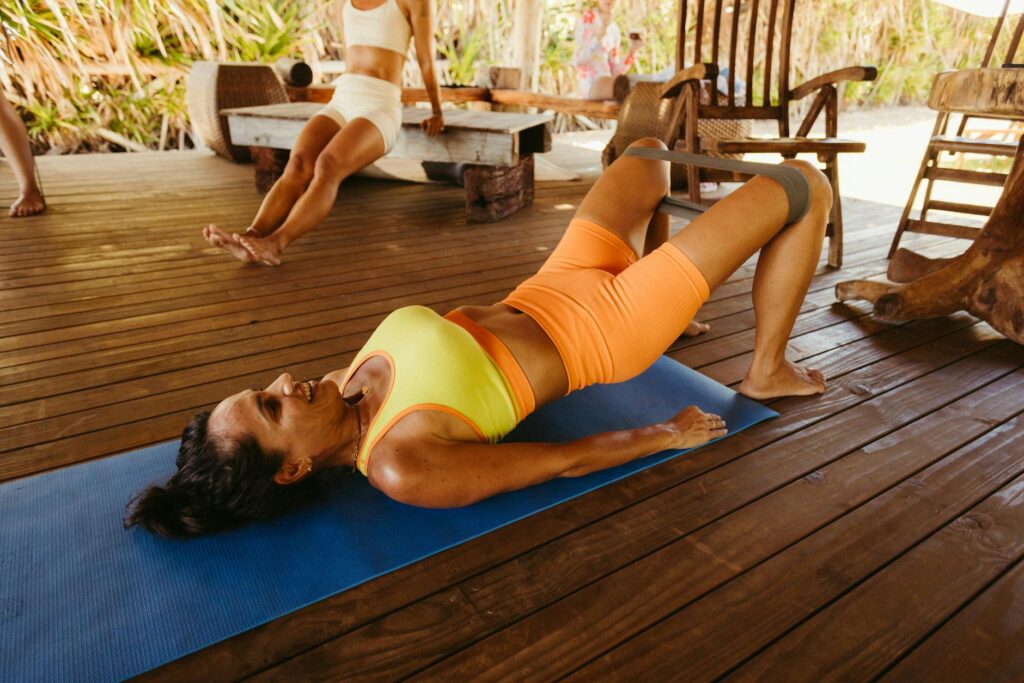
The most effective glute exercise available, period. Adding a band (looped above the knees) adds abductor activation on top of the glute max stimulus from the hip thrust itself. Use a bench, weight plate, or barbell for load. Drive hips to full extension, squeeze glutes hard at the top for a full second. The band cue forces the knees to stay wide, which prevents knee cave and increases glute activation.
2. Lateral Band Walk
Place a mini band above the knees or around the ankles. Take lateral steps in a half-squat position, maintaining constant tension on the band. This targets the gluteus medius and minimus: the hip abductors responsible for knee stability, hip stability, and the side-of-glute development that squats and hip thrusts do not reach. Ten steps each direction, three rounds, is a complete abductor session.
3. Clamshell
Lying on your side with hips stacked and knees bent to 90 degrees, band above the knees. Rotate the top knee open like a clamshell, maintaining foot contact. This is the most effective isolation exercise for the gluteus medius and external hip rotators, muscles that are chronically underactivated in athletes who sit for extended periods. Slow, controlled reps with a pause at peak rotation.
4. Banded Squat
Place a mini band above the knees. Squat with active cue to drive knees out against the band throughout the movement. The band tension forces continuous glute medius and external rotator activation to prevent knee cave, turning a standard squat into a glute-focused movement. This is also one of the best warm-up tools before heavy squat sessions to pre-activate the glutes and groove correct knee tracking.
5. Donkey Kick
On hands and knees with a band looped above one knee, kick the banded leg back and up to full hip extension. The band adds resistance at full extension, exactly where glute activation peaks. Slow, controlled movement with a deliberate squeeze at the top. Three sets of 15–20 reps per side as a finisher after compound glute work produces significant glute activation and muscle burn.
Comparison: All Four Bands Side by Side
| Band | Price | Type | Best Use | Skin Comfort |
|---|---|---|---|---|
| Fit Simplify | $14 (set of 5) | Latex loop | Daily glute training, full resistance range | Good |
| Rogue Monster | $28–$42 | Heavy rubber loop | Banded barbell work | Low (not for skin) |
| Peach Bands | $22 | Fabric loop | Lateral work, comfort-focused | Excellent |
| Theraband CLX | $18 | Looped therapy band | Travel, upper + lower body versatility | Good |
Check Fit Simplify Bands Price →
Frequently Asked Questions
Do resistance bands actually build glutes?
Yes, research consistently shows significant glute activation and hypertrophy from resistance band training, particularly for hip abduction and hip extension movements. Bands are most effective when combined with barbell or dumbbell work (banded barbell hip thrusts are the gold standard), but band-only programs produce meaningful glute development for beginners and intermediate athletes. The tension profile of bands (increasing resistance through range of motion) is uniquely well-suited to the glute’s strength curve.
What resistance band weight should I start with?
For most women starting glute training: the medium resistance band in a set like Fit Simplify. It should be challenging but allow 15 full reps with good form for lateral walks and clamshells. The heavy band is appropriate for hip thrusts and squats where the movement is stronger. Buying a set of 3–5 resistance levels is better than a single band, different exercises demand different tensions.
How often should I train glutes with bands?
Glutes recover faster than most muscle groups due to their size and blood flow. Most athletes benefit from 3–4 glute-focused sessions per week, with at least one rest day between heavy sessions. Band activation work (lateral walks, clamshells) can be done daily as a warm-up without impacting recovery. Direct loading (hip thrusts, banded squats with significant load) should be separated by at least 48 hours.
Why does my resistance band keep rolling up?
This is a latex band problem during lateral movements, the band rolls because it is smooth and narrow. Solutions: (1) switch to a fabric band like Peach Bands, which do not roll, (2) use a wider band (2–3 inches vs 1 inch), or (3) place the band slightly higher on the thigh where there is more surface area. The Fit Simplify bands at 2 inches wide are notably better than 1-inch budget bands for staying in place.