
Best Massage Gun Under $100 in 2026: Do You Need to Spend More?
The Theragun Pro costs $599. The Renpho R4 costs $50. The difference in tissue penetration between them is smaller than the marketing suggests. Here is when to spend more, and when the budget option is the right call.
The Renpho R4 Pro at $60–$70 handles 90% of what a Theragun Prime does at one-third the price. Buy premium when you need: deep tissue work requiring 16mm+ amplitude, a medical-grade device for acute injury management, or silent operation for shared spaces. For daily maintenance and DOMS reduction, under-$100 options are genuinely adequate.
The massage gun category has seen significant price compression over the past four years. Devices that cost $300+ in 2020 are now being matched in core specifications by $60–$100 options. The key variables: motor amplitude (how far the head travels per stroke), stall force (how much pressure before the motor stalls), and noise level, have converged significantly between budget and premium options, while battery life and build quality remain the most meaningful differentiators at the higher price points.
The Specification That Actually Matters: Amplitude
Amplitude (the distance the massage head travels per stroke) determines how deep into muscle tissue the device can reach. Standard consumer massage guns use 10–12mm amplitude, which is effective for superficial muscles and general soreness. High-amplitude devices (16mm, like the Theragun) reach deeper into dense muscle groups (glutes, hamstrings, upper back traps). The research does not yet show clear clinical superiority of high amplitude over standard amplitude for most applications, but athletes who report that budget devices “feel like they’re just vibrating on the surface” are correctly identifying this amplitude limitation on dense muscle groups.
For most athletes using a massage gun on relatively accessible muscles (quads, calves, IT band, shoulders, forearms), standard amplitude performs adequately. Athletes targeting deep hip musculature, thick upper traps, or dense glutes may genuinely benefit from higher amplitude.
#1 Best Under $100: Renpho R4 Pro Massage Gun
The Renpho R4 Pro is the most capable under-$100 massage gun available. 12mm amplitude, six speed settings (1,400–3,200 RPM), six attachment heads, 2,500mAh battery (up to 6 hours use), and a noise level of 35–45dB at low settings, genuinely quiet enough for early morning use without waking a partner. The build quality is solid rather than premium. The housing does not have the dense feel of a Theragun, but it does not feel cheap either. For daily maintenance work, it performs indistinguishably from devices costing three times as much.
#2 Best Mid-Budget: Theragun Relief (~$99)
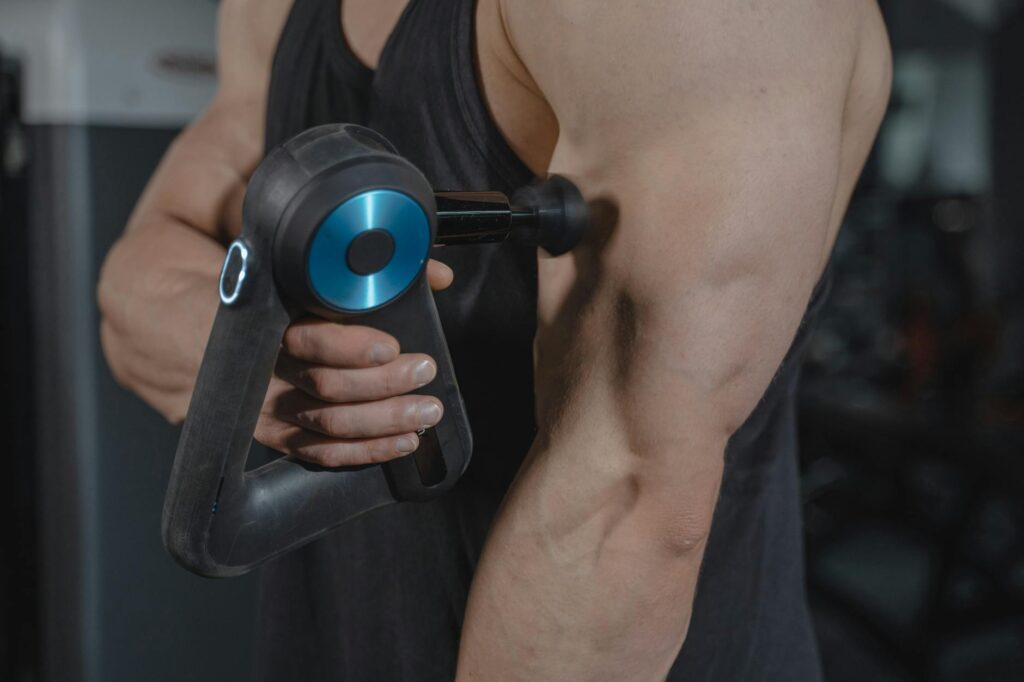
Theragun’s entry-level device uses the same triangular ergonomic handle design as the premium models, making it easier to reach your own back without a partner. 10mm amplitude keeps it in the standard range, four speeds cover most use cases, and the Theragun name carries validation from professional athletic training rooms that budget brands do not have. At $99, it is at the top of the “under $100” category but delivers genuine brand reliability and the ergonomic advantage that actually makes it easier to use on yourself. The handle design alone is worth paying extra for athletes who primarily self-treat.
When to Spend More: Theragun Prime vs Budget Options
The Theragun Prime ($199) and Theragun Pro ($599) are worth the premium in specific situations: you need the 16mm amplitude for deep tissue work on dense muscle groups; you treat clients or team members professionally and need medical-grade reliability; you require the quietest possible operation (QuietForce Technology reduces noise to 40–60dB even at high speeds); or you want Bluetooth connectivity to the Therabody app for guided routines and recovery protocols.
The Hypervolt Go 2 ($129) is worth mentioning as a mid-point option: compact, 12mm amplitude, 3 speeds, genuinely quiet, and significantly lighter than any Theragun model at 1.5 lbs. For athletes who travel frequently and want a device small enough to fit in a gym bag, the Hypervolt Go 2 makes more practical sense than either a bulky budget device or a full-size premium model.
How to Use a Massage Gun Effectively
Slow, deliberate passes along muscle bellies, not rapid back-and-forth scrubbing. Spend 30–60 seconds per muscle group, moving 1–2 inches per second. For tender spots, hold stationary pressure for 10–20 seconds rather than continuing to move. Avoid bony prominences (spine, shoulder blade ridge, kneecap, shin bone directly). The device is for muscle tissue, not bone. Never use on fresh bruising, open wounds, or inflamed joints.
Pre-workout: 30–45 seconds per muscle group at a moderate speed (not maximum) to warm up tissue and reduce stiffness. Post-workout: 60–90 seconds per worked muscle group at a comfortable intensity to promote blood flow and reduce DOMS. On timing, we previously stated that repeat sessions at 0, 24 and 48 hours produce the most consistent soreness reduction. The systematic review of percussive therapy in the International Journal of Sports Physical Therapy (2023) does not support that level of specificity: nine of the thirteen studies it examined used a single application ranging from 30 seconds to 30 minutes, and only four used repeated treatments, so there is no established optimal schedule. Effects were concentrated in flexibility and pain rather than performance. Treat repeat sessions as reasonable and unproven, and treat the honest summary as this: a short session on a sore muscle helps how it feels, and the schedule is up to you.
Common Questions
Can a massage gun replace professional massage?
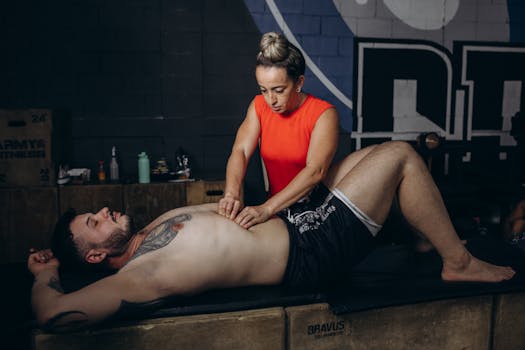
For daily maintenance and DOMS management, a massage gun is a practical complement or partial substitute. For clinical work: acute injury management, deep tissue specific problem areas, or structural assessment, professional massage or physical therapy is not replaceable by a device. The best approach uses both: daily self-treatment at home, professional treatment monthly or when specific issues arise.
How long should a massage gun session last?
10–15 minutes for a full-body maintenance session. 2–3 minutes per muscle group if targeting specific areas. Research on optimal duration is limited, but there is no evidence that longer sessions produce proportionally better outcomes, quality of application matters more than duration.
Is it safe to use a massage gun on your neck?
On the neck musculature (upper traps, sternocleidomastoid, scalenes) at low speed: yes, with care. Never use on the front of the neck over the carotid artery. Never use on the cervical vertebrae directly. Stick to the muscle bulk of the upper traps and suboccipital area at low intensity. If you have any cervical spine pathology, consult a physiotherapist before using a massage gun on the neck.
What $100 Actually Buys You in a Massage Gun
The massage gun market has compressed dramatically over the past three years. Features that cost $250–$300 in 2020: brushless motors, quiet operation, interchangeable heads, variable speed settings, are now available under $100 from several manufacturers. The honest assessment: for most athletes who use a percussion device 3–4 times per week for warm-up and post-workout recovery, a quality under-$100 massage gun produces indistinguishable results from a Theragun Pro at five times the price.
Where the premium devices still justify cost: amplitude. The Theragun Prime has 16mm amplitude, the distance the head travels per stroke. Most under-$100 devices have 10–12mm amplitude. For athletes working deep tissue in large muscle groups (glutes, hamstrings, thoracic paraspinals), higher amplitude reaches tissue more effectively. For general warm-up, surface recovery, and lighter percussion work, 10–12mm is fully adequate.
How to Use a Massage Gun Correctly
Speed setting: start lower (1,800–2,000 RPM) on sensitive or acutely sore areas and use higher speeds (2,400–3,200 RPM) on larger, less sensitive muscle groups for warm-up. Holding at maximum speed on a sensitive area immediately post-workout is one of the most common mistakes, it increases discomfort without producing better recovery outcomes.
Pressure: let the device float across the muscle surface rather than pressing hard into the tissue. The percussion mechanism does the work; additional manual pressure does not meaningfully increase tissue penetration at these amplitude levels. Heavy pressing fatigues your arm, reduces the effectiveness of the percussive stroke, and can cause bruising on sensitive areas.
Duration: 60–90 seconds per muscle group is sufficient for warm-up or post-workout use. More time does not produce proportionally more benefit. For a full-body recovery session after a hard training day: quads (90s each), hamstrings (90s each), glutes (60s each), calves (60s each), upper back (60s), shoulders (45s). Total time: approximately 12–15 minutes.
When a Cheap Massage Gun Fails, Red Flags to Watch For
Not all under-$100 massage guns are equal. Several common failure modes in low-quality units: motors that overheat after 10–15 minutes of continuous use (the device shuts off or produces burning smell), brush-based motors that are significantly louder than advertised, battery life that deteriorates rapidly after 3–6 months of regular use, and plastic housings that crack under normal use force.
Reliable indicators of quality in the under-$100 tier: brushless motor specification (look for this explicitly in product descriptions), at least 3 speed settings, interchangeable head attachments (ball, flat, fork, bullet), and a reputable brand with accessible customer service. The Opove M3 Pro, Bob and Brad D5 Pro, and Renpho R3 have each maintained reliable reputations at their price points across hundreds of verified user reviews.
Frequently Asked Questions
Is a massage gun better than a foam roller?
They address overlapping but distinct needs. Foam rolling covers large surface areas quickly and is better for pre-workout rolling and broad muscle group work. Massage guns provide targeted deep percussion on specific points, are better for addressing individual trigger points, and are more effective for warm-up activation of specific muscles. Most athletes who use both tools report they are complements rather than substitutes: foam roll first for broad coverage, then use the massage gun for specific tight areas.
Are cheap massage guns safe?
Quality under-$100 massage guns from reputable manufacturers are safe for typical athletic use. The risks associated with massage guns (bruising, nerve damage, hematoma) are not related to price tier but to user technique (holding on bony areas, over-pressuring, using on acute injuries or inflamed tissue). Avoid using any percussion device directly on bones, joints, the spine, or areas of acute injury, regardless of the device’s price.
Related: Theragun Prime Review · Best Foam Roller · Best Recovery Gear · How to Build a Recovery Stack